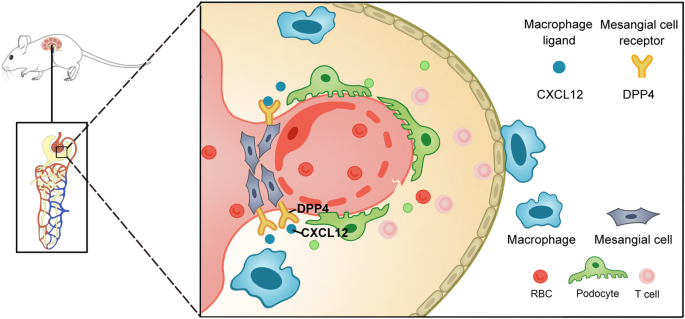
To understand Mesangial Cell Signaling, imagine each kidney nephron like a tiny water-treatment factory. Inside the glomerulus (the filter), we have three important workers:
| Structure | Function |
|---|---|
| Endothelial cells | Let plasma through but block blood cells |
| Basement membrane | Main filter mesh |
| Podocytes | Final filtration gate |
Mesangial cells are the support engineers inside this filter. They don’t filter blood — they regulate and control the environment so filtering happens properly.
Think of them like the muscle-immune-support hybrid managers of the glomerulus.
What Are Mesangial Cells?
Mesangial cells are special cells located:
✅ Between capillary loops inside the glomerulus (intraglomerular)
✅ Outside glomerulus near the afferent arteriole (extraglomerular) — part of the juxtaglomerular apparatus
They are similar to smooth muscle cells + macrophages in behavior.
Main Jobs of Mesangial Cells
| Function | Meaning |
|---|---|
| Support | Physically support glomerular capillaries |
| Contract | Change capillary surface area → alter GFR |
| Phagocytosis | Clean trapped proteins + debris |
| Secrete matrix | Maintain structural framework |
| Immune signaling | Release cytokines in inflammation |
They’re like janitors + security guards + plumbers all in one.
Why Their Signaling Matters
Mesangial cell signaling controls:
- Glomerular filtration rate (GFR)
- Capillary blood flow
- Response to injury
- Inflammation
- Kidney disease progression (e.g., diabetic nephropathy, IgA nephropathy)
So when signaling goes wrong ➜ glomerular diseases develop.
How Mesangial Cell Signaling Works
Mesangial cells respond to chemical signals like:
| Signal Type | Examples | Effect |
|---|---|---|
| Vasoconstrictors | Angiotensin II, Endothelin | Mesangial cell contraction → ↓ GFR |
| Vasodilators | Nitric oxide (NO), ANP, Prostacyclin | Relaxation → ↑ GFR |
| Inflammatory | IL-1, TNF-α, Complement C5a | Cytokine release, matrix growth |
| Metabolic | High glucose, ROS | Cell proliferation, fibrosis |
1. Angiotensin II (Powerful Constrictor)
Ang II binds mesangial cell receptors →
- Contraction of mesangial cells
- ↓ filtration surface area
- ↓ GFR
Also stimulates:
- Matrix production
- Inflammatory cytokines
- Cell proliferation
💡 Overactive in hypertension and diabetic nephropathy
2. NO & ANP (Relaxing Signals)
These cause mesangial cells to relax:
- ↑ surface area
- ↑ GFR
- ↑ blood flow
💡 Think of ANP as “anti-Angiotensin” for kidneys.
3. Complement System (In Immune Injury)
Especially C5a in immune nephropathies (e.g., IgA nephropathy).
Effects:
- Attracts immune cells
- Mesangial proliferation
- Cytokine release
💡 This is why IgA nephropathy causes mesangial hypercellularity.
✔️ 4. High Glucose (Diabetes)
High glucose triggers:
- Mesangial hypertrophy & proliferation
- Excess extracellular matrix → thickened mesangium
- ↑ TGF-β, ROS (oxidative stress)
Results in:
- Glomerular sclerosis
- Proteinuria
- Reduced GFR gradually
💡 This is why ACE inhibitors help protect kidneys in diabetes — they reduce Ang II effects.
🧬 Intracellular Pathways
| Pathway | Trigger | Effect |
|---|---|---|
| Ca²⁺/Calmodulin | Ang II | Contraction |
| Protein Kinase C | High glucose | Matrix expansion |
| NO-cGMP | ANP, NO | Relaxation |
| NF-κB | Cytokines | Inflammation & cytokine release |
Mesangial Cells as Kidney Janitors
They remove:
- Trapped immune complexes
- Old proteins
- Damaged matrix
But if overloaded (e.g., IgA deposits), they:
- Proliferate excessively
- Secrete too much matrix
- Cause glomerular scarring
Mesangial-Related Disease Clues
| Condition | Key Feature |
|---|---|
| IgA nephropathy | Mesangial IgA deposits + proliferation |
| Diabetic nephropathy | Thick mesangium, excess matrix |
| Lupus nephritis | Immune complex deposition |
| Hypertension | Ang II → contraction & fibrosis |
Quick Memory Trick
“Mesangial cells = MUSCLE + MACROPHAGE + MATRIX”
- Muscle → contract to control GFR
- Macrophage → clean up debris
- Matrix → maintain glomerular structure
Final Summary
- Mesangial cells support capillaries and regulate filtration surface
- Contraction ↓ GFR (Ang II, endothelin)
- Relaxation ↑ GFR (NO, ANP)
- Act as phagocytes & immune responders
- Overactivation → fibrosis & glomerular disease (esp. diabetes, IgA nephropathy)
Pingback: Ultrafiltration — A simplified Concept » The Learning Hub