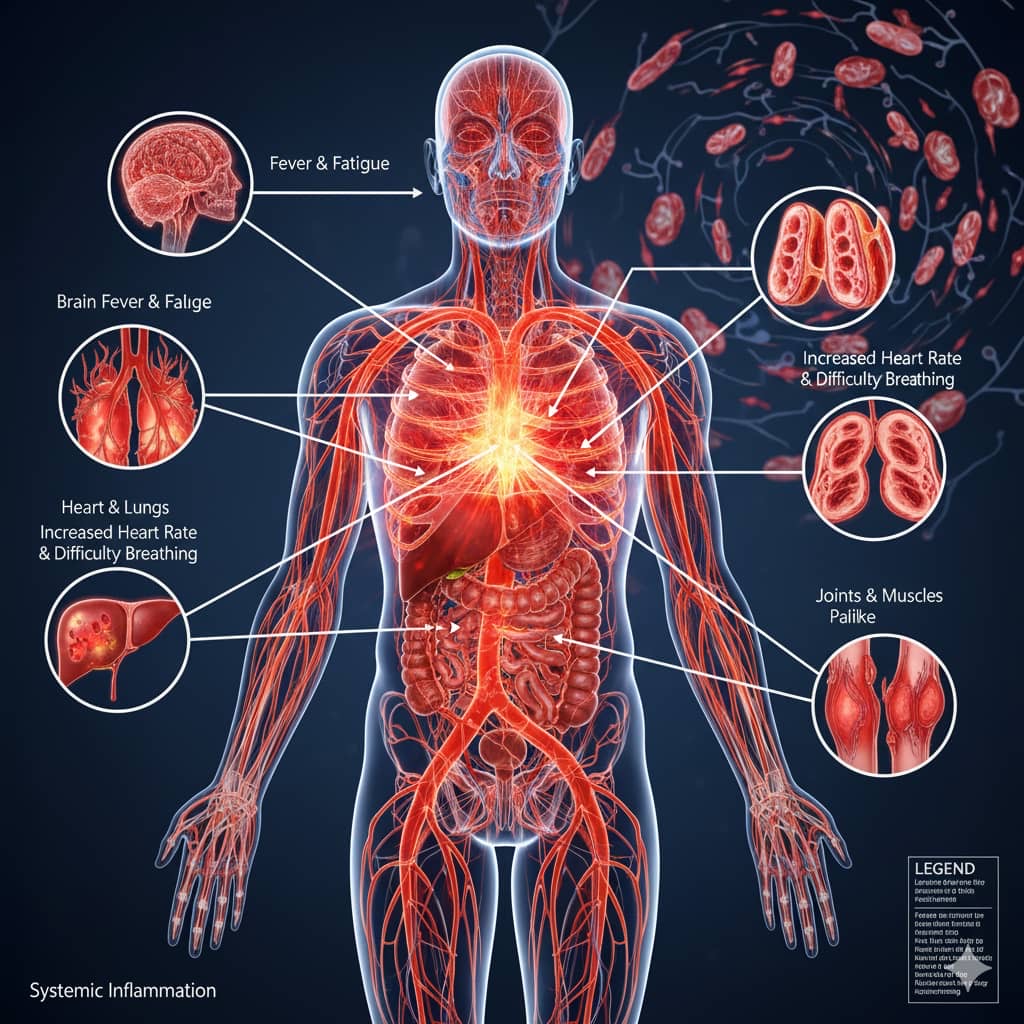
🔹 What is Inflammation?
Inflammation is the body’s protective response to injury, infection, or irritation.
Its goal is simple:
- Eliminate the cause of injury (like microbes or toxins).
- Clear out damaged tissue.
- Start repair.
It is not always harmful — it’s a survival mechanism. But when excessive or uncontrolled, inflammation itself can cause disease.
🔹 The Classic Signs
Historically, inflammation is remembered by the five cardinal signs (from Roman medicine):
- Redness (Rubor) – due to increased blood flow.
- Heat (Calor) – also from increased blood flow and metabolism.
- Swelling (Tumor) – fluid leakage into tissues.
- Pain (Dolor) – chemical mediators stimulating nerves.
- Loss of function (Functio laesa) – impaired movement or activity.
🔹 Types of Inflammation
- Acute Inflammation
- Rapid, short-lived (minutes to days).
- Dominated by neutrophils.
- Aims at quick defense and repair.
- Chronic Inflammation
- Long-lasting (weeks to years).
- Dominated by lymphocytes, macrophages, fibroblasts.
- Leads to tissue damage and scarring (fibrosis).
🔹 The Steps of Acute Inflammation (Simplified Timeline)
- Vascular Changes
- Injury/infection triggers release of chemicals (like histamine, nitric oxide).
- Blood vessels dilate → more blood (redness, heat).
- Vessel walls become leaky → plasma proteins and fluid enter tissues (swelling).
- Cellular Events
- Neutrophils are first responders.
- They move from blood → tissue by a process called extravasation:
- Margination → stick to vessel walls.
- Rolling → interact weakly with endothelial cells.
- Adhesion → firm attachment via integrins.
- Transmigration → squeeze between endothelial cells into tissue.
- Phagocytosis & Killing
- Neutrophils and macrophages engulf bacteria/debris.
- Use reactive oxygen species, nitric oxide, and enzymes to destroy invaders.
- Resolution or Repair
- If injury clears → healing begins.
- If not → progresses to chronic inflammation.
🔹 Chemical Mediators of Inflammation
Inflammation is basically a chemical orchestra. Key mediators include:
- Histamine → from mast cells; increases vascular permeability.
- Prostaglandins → cause fever, pain, vasodilation.
- Leukotrienes → attract white blood cells.
- Cytokines (IL-1, TNF-α, IL-6) → coordinate the whole response, cause fever.
- Complement system proteins → punch holes in microbes, attract immune cells.
🔹 Anatomy Behind It
- Blood vessels → the main stage for vascular changes.
- Endothelial cells → control entry of immune cells.
- Connective tissue → where fluid and immune cells accumulate.
- Local nerves → transmit pain signals when irritated by mediators.
🔹 Biochemistry Behind It
- Arachidonic Acid Pathway (from cell membranes):
- Cyclooxygenase (COX) → Prostaglandins, Thromboxanes.
- Lipoxygenase → Leukotrienes.
- These products explain why NSAIDs (like ibuprofen) work — they block COX, reducing prostaglandins → less pain, swelling, fever.
- Reactive Oxygen Species (ROS): Used by neutrophils to kill microbes.
- Nitric Oxide: Vasodilator and antimicrobial.
🔹 Chronic Inflammation
When the cause is not eliminated, or in autoimmune diseases, acute inflammation transitions to chronic.
- Cells involved: Lymphocytes (T, B cells), macrophages, plasma cells.
- Features: Continuous tissue destruction, attempts at repair (fibrosis, angiogenesis).
- Examples: Tuberculosis, rheumatoid arthritis, chronic hepatitis.
🔹 Clinical Relevance
- Pneumonia: Acute inflammation in the lungs.
- Asthma: Chronic airway inflammation.
- Atherosclerosis: Chronic inflammation of arterial walls.
- Autoimmune diseases: Inappropriate inflammation against self-tissues.
- Anti-inflammatory drugs:
- Steroids → suppress cytokines, broad anti-inflammatory effect.
- NSAIDs → block prostaglandins, relieve pain and fever.
- Biologics (like anti-TNF drugs) → target specific cytokines.
🔹 Summary for Students
Inflammation is the body’s first line of organized defense when tissues are injured.
- Acute: Fast, neutrophil-driven, short-term.
- Chronic: Slow, lymphocyte/macrophage-driven, long-term, tissue damage.
- Mediators: Histamine, prostaglandins, cytokines, complement.
- Purpose: Eliminate cause, clear debris, repair tissue.
👉 Think of inflammation as a firefighting team:
- Fire trucks rush in (neutrophils).
- Hoses spray water everywhere (fluid leakage).
- Commanders give orders (cytokines).
- If the fire is controlled → clean-up and rebuilding (healing).
- If not → smoldering fire that damages the house itself (chronic inflammation).
Mnemonic to Remember:
“Inflammation = Red, Hot, Swollen, Painful, and Lost.”
Pingback: Cell Margination Explained: Simple Guide for Med Students