
Navigation: Home → Belief Systems → Christianity → What is the “True” Church?
Estimated Reading Time: 15 minutes
Difficulty: Beginner / Curious Explorer
A Building with Many Rooms
Imagine you’re looking for a friend in a massive, ancient building. You open one door and find a room filled with ornate gold decorations, the scent of incense, and a hushed, reverent silence. You open another and find a simple room with wooden benches, where a speaker is passionately explaining a passage from a book. You open a third and find a vibrant room with loud music, hands raised in the air, and an atmosphere of electric joy.
All these people claim to be in the same building, looking for the same friend. But are they? And more importantly, which room leads to the right destination?
This is the heart of the question: What is the “True” Church? For nearly two thousand years, Christians have wrestled with this. It’s a question about belonging, about truth, and about what it really means to follow Jesus. It’s a question that has inspired crusades, sparked reformations, and shaped the lives of billions. And it’s a question with no single, simple answer—but many fascinating ones.
The Problem: A House Divided
On the surface, the question seems straightforward. If there is a God and Jesus is his son, wouldn’t he have left one, clear, unified institution on Earth?
Yet, anyone who looks at the Christian landscape today sees a mosaic of thousands of different groups—denominations, they’re often called. There are Roman Catholics, Eastern Orthodox, Baptists, Methodists, Pentecostals, Lutherans, Presbyterians, Anglicans, and countless independent churches . Each has its own style of worship, its own set of beliefs, and its own way of organizing itself.
[Did you know?] There are an estimated 45,000 Christian denominations globally. This number can be misleading, as it counts many small, independent churches. However, it illustrates the incredible diversity within a faith that began with a small group of followers in Jerusalem .
If you ask leaders from different groups if their church is the “true” one, you’ll get very different answers. Some will say, “Of course, ours is the one true church.” Others will say, “The true church isn’t a building or an organization; it’s the people.” Still others will say, “The true church is wherever the true message is preached.”
This isn’t just a modern problem. It’s been a point of contention since the very beginning. Let’s take a journey through time to see how we got here.
🕰️ Timeline Visualization: The Great Divisions
Understanding the “True Church” question means understanding the major cracks that have appeared in the Christian foundation over two millennia.
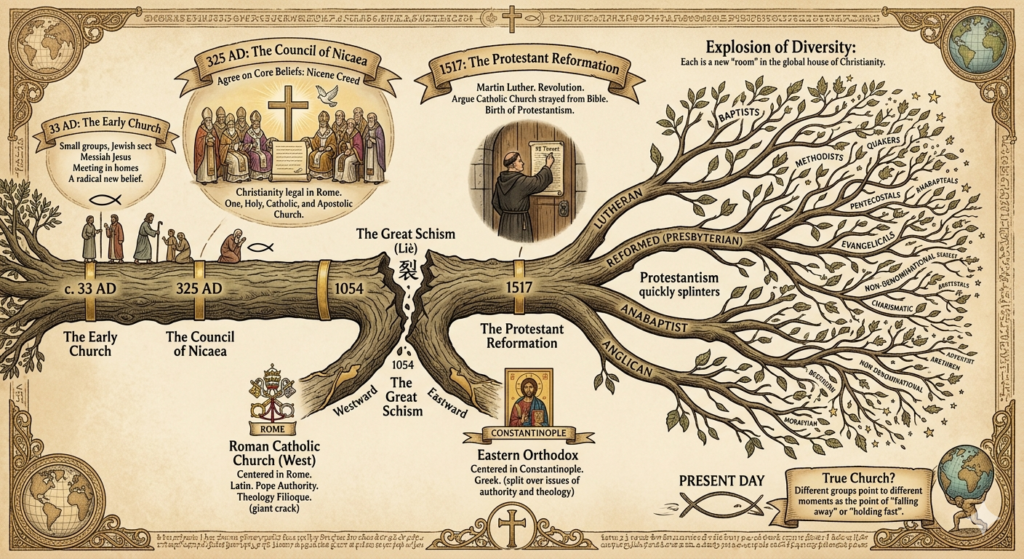
[Visual Timeline Image: A horizontal timeline from 33 AD to Present Day, with key branching points labeled. The line starts as a single trunk, then splits into branches at 1054 and 1517, with many smaller branches sprouting after 1517.]
- c. 33 AD: The Early Church is born in Jerusalem. It’s a small Jewish sect with a radical new belief: that Jesus is the promised Messiah . There is no “church” as we know it—just small groups meeting in homes.
- 325 AD: The Council of Nicaea. As Christianity grows and becomes legal in the Roman Empire, leaders hold a global meeting to agree on core beliefs. They create the Nicene Creed, a statement of faith that most Christians still accept today. For centuries, the church is united (in theory) under a single umbrella, often called the “One, Holy, Catholic, and Apostolic Church” .
- 1054: The Great Schism. Think of this as the first giant crack. The church splits into two halves: the Roman Catholic Church in the West (centered in Rome, using Latin) and the Eastern Orthodox Church in the East (centered in Constantinople, using Greek). They split over issues of authority (does the Pope have supreme power?) and theology (a small but significant word called filioque was added to the creed) .
- 1517: The Protestant Reformation. Martin Luther, a German monk, nails his 95 Theses to a church door, sparking a revolution. He and other reformers like John Calvin argue that the Catholic Church has strayed from the Bible. This leads to the birth of Protestantism, which itself quickly splinters into many branches: Lutheran, Reformed (Presbyterian), Anabaptist, and later, Anglican .
- 1500s – Today: Explosion of Diversity. From the Protestant branches come countless others: Baptists, Methodists, Quakers, Pentecostals, Evangelicals, and non-denominational churches. Each is a new “room” in the global house of Christianity .
This history shows us that the question of the “True Church” is often answered by different groups pointing to different moments in this timeline as the point of “falling away” or “holding fast.”
The Search for the “Marks” of the True Church
So, if you’re a seeker, how do you know which group has it right? For centuries, theologians have developed “marks” or “notae” (Latin for signs) to identify the true church. It’s like having a checklist to find the authentic article.
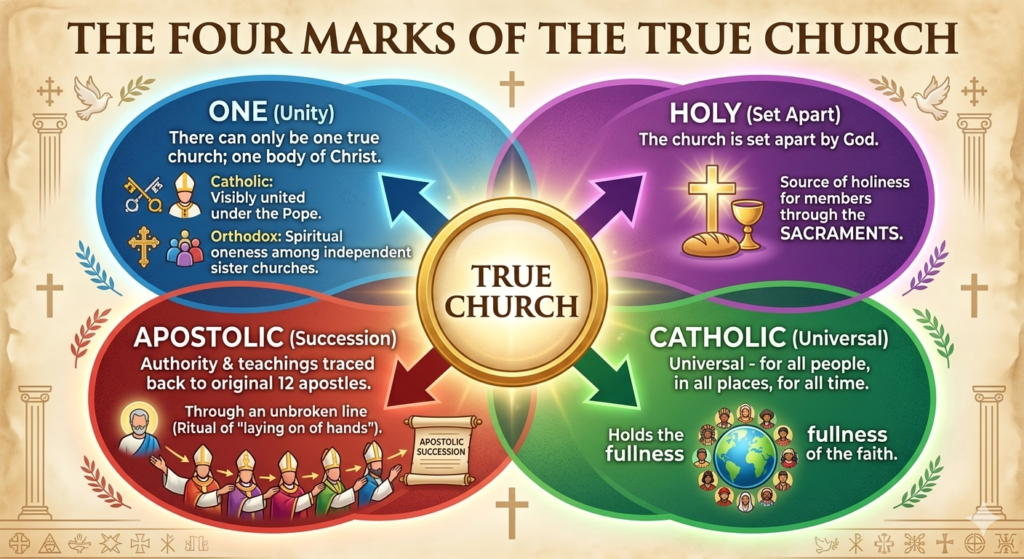
[Visual Diagram: A circle with the word "True Church" in the center. Around it, four overlapping circles represent different potential "marks" or characteristics, with arrows pointing inward.]
Different traditions have different checklists. Let’s look at the most influential ones.
1. The Traditional Catholic & Orthodox View: The Four Marks
Both the Catholic and Orthodox churches profess belief in the “Four Marks of the Church” as stated in the Nicene Creed: the church is One, Holy, Catholic, and Apostolic. They agree on the marks but interpret them differently.
- One: There can only be one true church because there is only one body of Christ. For Catholics, this oneness is visibly united under the Pope. For the Orthodox, it’s a spiritual oneness shared by independent but sister churches that all hold the same ancient faith .
- Holy: The church is set apart by God and is the source of holiness for its members through the sacraments.
- Catholic: This doesn’t mean “Roman Catholic.” It means “universal.” The true church is for all people, in all places, for all time. It holds the fullness of the faith.
- Apostolic: The true church’s authority and teachings can be traced in an unbroken line back to the original 12 apostles, through a ritual called the “laying on of hands.” This is known as apostolic succession .
[Did you know?] The “apostolic succession” is like a spiritual family tree. Catholics and Orthodox believe that their bishops, priests, and deacons are direct descendants in a chain of ordination that goes back 2,000 years to Peter, Paul, and the other apostles. This unbroken chain is seen as a guarantee of authentic teaching and authority .
2. The Protestant View: Where the Word Is
The Protestant reformers, like Martin Luther and John Calvin, offered a different set of marks. They argued that the Catholic church had become corrupt and lost its way. The true church, they said, isn’t found in a building or a hierarchy, but wherever two or three things are truly present .
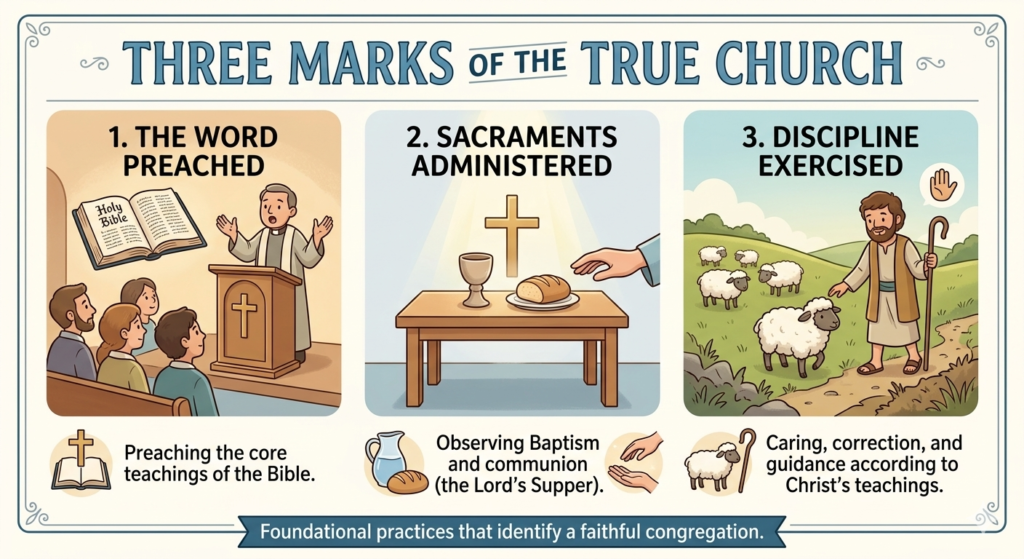
[Short Explainer Illustration: A simple drawing of a Bible open on a pulpit (the Word Preached), a simple table with a cup and bread (Sacraments Administered), and a shepherd gently guiding a sheep (Discipline Exercised).]
According to the Reformed tradition (Presbyterian, Congregational, etc.), the true church is where:
- The Word of God is purely preached. This means the central message of the Bible—salvation by grace through faith in Christ—is taught clearly and accurately. This is the most important mark .
- The Sacraments are rightly administered. The two sacraments instituted by Christ—Baptism and the Lord’s Supper (Communion)—are performed in the way he commanded.
- Church discipline is faithfully exercised. This means the church has a process for encouraging its members to live according to Christian teaching and for restoring those who fall into serious error or sin .
[You might also wonder…] But what if a church has these marks, but isn’t perfect? Great question! John Calvin himself acknowledged that no church on Earth is perfect. A church can have some mixture of error and still be a “true” church, as long as it hasn’t completely destroyed these core marks. The Westminster Confession of Faith (a key Reformed document) states: “The purest churches under heaven are subject to mixture and error” .
3. The Believer’s Church View: A Community of Committed Hearts
Other groups, often called “Anabaptists” (like Mennonites and Amish) or “Believer’s Churches” (like many Baptists), added another layer. For them, the true church isn’t defined by a building, a hierarchy, or even just the preaching. It’s defined by its members.
In this view, the true church is a voluntary assembly of people who have consciously and personally decided to follow Jesus. You aren’t born into it; you join it by making a personal decision (believer’s baptism). The mark of the true church is the visible holiness and mutual care of its community .
4. The Latter-day Saint View: Restoration of Authority
The Church of Jesus Christ of Latter-day Saints (sometimes called Mormons) has a unique perspective. They believe that after the death of the original apostles, the true church and its authority (priesthood) were completely lost from the Earth in a “Great Apostasy.” Therefore, none of the churches that emerged from the Reformation could be the true church.
They believe that in the 1820s, God the Father and Jesus Christ appeared to a young boy named Joseph Smith to restore the true church. For them, the marks of the true church are: direct revelation from God through a living prophet, the same priesthood authority as the ancient church, and the same spiritual gifts (healing, prophecy, etc.) .
🗺️ Comparative Table: How Different Traditions See the “True Church”
Let’s put these views side-by-side to see how they compare.
So, What is the “True” Church? A Deeper Look
After this journey through history and theology, we can see there isn’t one answer, but several profound ways of thinking about the question itself. The answer depends on what you’re looking for.
1. The “True” Church as an Institution
For Catholics, Orthodox, and Latter-day Saints, the church is primarily a visible institution with a clear structure, authority, and set of rules. Being “in” the true church means being part of that specific organization. The question is a matter of objective truth: who has the right history, the right leaders, and the full truth?
2. The “True” Church as a Place of Grace
For many Protestants, the church is less about the institution and more about the means of grace. The true church is wherever God’s grace is reliably found—through the preaching of his Word and the giving of the sacraments. The institution is a vehicle for this grace. If a church stops faithfully distributing these gifts, it ceases to be a true church in any meaningful sense .
3. The “True” Church as an Invisible Body
This is a key concept for almost all Protestants. They distinguish between the visible church (all the people on the membership rolls) and the invisible church (the true believers known only to God). From this perspective, the “True Church” is not an organization you can join by filling out a form. It’s the spiritual body of all genuine believers throughout history, known only to God. You can’t see it, but it’s the only one that ultimately matters .
4. The “True” Church as a Future Promise
The Bible also speaks of the church as the “Bride of Christ,” who is being prepared for a great wedding feast at the end of time. In this view, the “True Church” is not fully realized yet. It’s a people being shaped and purified, looking forward to a future day when it will be presented to Christ in all its glory, “without stain or wrinkle or any other blemish” (Ephesians 5:27). The true church is a promise of what will be.
🔮 Future Implications: What is the Church Becoming?
The question of the “True Church” isn’t just about the past; it’s about the future. How we answer it shapes how Christians will navigate the 21st century.
- The Rise of the Global South: Christianity’s center of gravity is shifting from Europe and North America to Africa, Asia, and South America. These growing churches often have a more supernatural worldview, leading to the explosive growth of Pentecostalism. This may redefine what “authentic” Christianity looks like on a global scale .
- The “Urban Monastic” Movement: As culture becomes more secular, some believe the church will need to become more counter-cultural. Small communities of Christians living with intentionality, discipline, and service in cities—a kind of “new monasticism”—may become a powerful new expression of the church .
- The Challenge of AI: How will artificial intelligence change the church? Could an AI write a sermon? Offer counsel? This forces a new kind of question about what it means for the church to be a truly human, embodied, and Spirit-led community .
- The Persecuted Church: In many parts of the world, being part of the “true church” carries a heavy price. For these believers, the question isn’t about labels or denominations, but about costly faithfulness, sometimes practiced in secret .
🧭 Your Knowledge Journey
You’ve just explored one of the most profound questions in Christian history. Where to next? Follow your curiosity.
"Next Concept to Learn" Suggestions
Apostolic Succession: Dive deeper into this ancient idea of spiritual authority passed down through the ages.The Great Schism: Explore the dramatic events of 1054 that split the Eastern and Western churches.The Protestant Reformation: Meet Martin Luther, John Calvin, and the other figures who changed the world.What is a Sacrament?: Understand the rituals that many Christians see as visible signs of God’s invisible grace.
Concept Clusters (Topic Ecosystems)
- Cluster: Christian History
Early Church→Council of Nicaea→Great Schism→Protestant Reformation
- Cluster: Ways of Believing
Catholicism↔Eastern Orthodoxy↔Protestantism↔Evangelicalism
Curated Reading Paths
- For the Beginner: Start with
What is Christianity?→Who was Jesus?→The Bible: A Beginner's Guide→ then return here. - For the History Lover:
Timeline of Christianity→The Great Schism→The Protestant Reformation→History of the Bible. - For the Comparativist:
What is a Denomination?→Catholicism vs. Protestantism→Core Beliefs of Major Traditions.
Related Experiments to Understand
- Thought Experiment: Imagine you are a Christian in a city with 100 different churches. Write down a list of 3 questions you would ask a pastor to determine if their church was “true.” Compare your questions to the “marks” in this article.
[Mini Knowledge Card: "Denomination"]
Term: Denomination
Definition: A recognized autonomous branch of the Christian Church. The term became common in the 18th century and implies that no single group has a monopoly on the “true church,” but that different groups represent different “names” (from Latin nominare, to name) within a larger Christian family .
[Concept Dependency Tree]
To understand this concept, you should first grasp:
Basic Christianity(The belief in Jesus as Lord)The Bible(The central sacred text)
This concept helps you understand:
Ecumenism(The movement to reunite Christians)Modern Christian Conflicts(Theological debates today)Comparative Religion
We hope this exploration has illuminated, not confused. The question of the “True Church” is ultimately an invitation to keep asking, keep learning, and keep seeking.