On a quiet night more than two thousand years ago, a light in the sky became a story that would echo through centuries.
It was not loud.
It did not blaze like a supernova in recorded history.
It did not tear the heavens open.
And yet, it endured.
The Star of Bethlehem remains one of the most discussed celestial phenomena in human memory — not because we know exactly what it was, but because it sits at a rare intersection: astronomy, history, faith, and the human instinct to search the sky for meaning.
To understand the Star of Bethlehem is not merely to ask what appeared in the sky, but to ask why humans have always looked upward when something important happens on Earth.
The Ancient Sky: A Different Way of Seeing
To modern eyes, the night sky is background scenery.
To ancient civilizations, it was language.
Before telescopes, satellites, or astrophysics, the sky was humanity’s first data archive. Movements of stars and planets were tracked meticulously, memorized, and interpreted. Astronomy and astrology were not separate disciplines — they were one continuous effort to understand order in the universe.
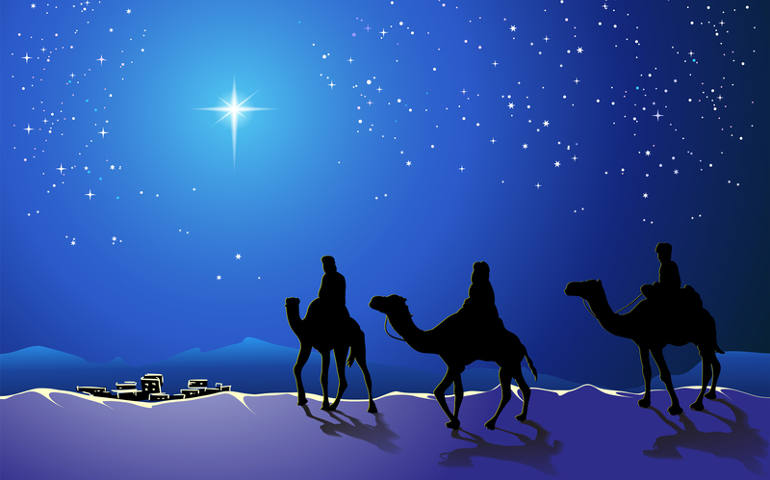
The Magi, often translated as “wise men,” were likely astronomer-priests from the East — possibly Babylon or Persia — regions famous for advanced celestial observation. These were not casual stargazers. They were scholars of the sky.
So when the Gospel of Matthew speaks of a “star” that was noticed, interpreted, and followed, it is describing an event that fit the intellectual framework of its time.
Whatever the Star of Bethlehem was, it had to be astronomically noticeable, symbolically meaningful, and rare enough to be interpreted as significant.
What Could the Star Have Been?
Modern astronomy does not dismiss the Star of Bethlehem. Instead, it asks a more careful question:
What real celestial events could ancient observers have reasonably described as a “star”?
Several candidates emerge — each fascinating, each incomplete, and each revealing something about how humans understand the cosmos.
1. A Planetary Conjunction: When Worlds Appear to Meet
One of the strongest scientific explanations is a planetary conjunction — a rare alignment where planets appear extremely close together in the sky.
In 7 BCE, a triple conjunction of Jupiter and Saturn occurred in the constellation Pisces. Jupiter, often associated with kingship, and Saturn, linked with time and destiny, would have drawn immense attention from ancient sky-watchers.
To the naked eye, this alignment would have appeared as an unusually bright and significant celestial event unfolding over months.
Importantly, conjunctions do not “move” like stars. Their slow, deliberate motion against the background sky could easily be interpreted as guiding rather than flashing briefly.
Astronomically real. Symbolically loaded. Rare.
Yet, conjunctions do not behave exactly as the biblical description suggests. They do not “stop” over a single location, nor do they shine as a single point of light.
This leads us to other possibilities.
2. A Comet: The Traveling Messenger
Comets are dramatic. They appear unexpectedly, glow visibly, and move across the sky over weeks or months.
Chinese astronomical records describe several comets around the time traditionally associated with Jesus’ birth. To ancient cultures, comets were powerful signs — sometimes ominous, sometimes transformative.
However, comets were often seen as symbols of upheaval or disaster, not birth or kingship. Additionally, early Christian tradition rarely depicted the Star of Bethlehem as a comet until much later artistic interpretations.
The comet explanation is plausible — but symbolically uneasy.
3. A Nova or Supernova: A New Light Ignites
A nova or supernova occurs when a star suddenly brightens dramatically, appearing where nothing was visible before.
To an ancient observer, this would look like a new star being born.
This idea fits the language well: a star that was not there before.
Yet here lies the problem: no clear historical records exist describing a supernova visible in that region of the sky during the proposed timeframe. Given how striking supernovae are, their absence from detailed records is difficult to ignore.
4. Something Else Entirely
It is also possible that the Star of Bethlehem was not a single event, but a narrative condensation of multiple signs, interpreted collectively rather than literally.
Ancient texts often used celestial language symbolically — not to deceive, but to communicate significance.
In this view, the Star was less a pinpoint of light and more a cosmic sentence written across the sky, read by those trained to interpret it.
Why the Sky Matters When Meaning Is at Stake
Here is the deeper truth often overlooked:
The Star of Bethlehem is not remarkable because it challenges science — but because it reveals how humans relate to the universe.
Throughout history, moments of transition — births, deaths, empires rising and falling — have been mirrored in the sky. Not because the stars cause these events, but because humans instinctively look outward when something inward feels profound.
The heavens are constant. Earth is fragile.
When meaning feels too large for words, humans reach for the sky.
Science and Symbolism Are Not Enemies
A modern mistake is assuming that if something has symbolic meaning, it must lack physical reality — or that if it has a scientific explanation, it loses its wonder.
The opposite is true.
A planetary conjunction does not become less awe-inspiring because we understand gravity. A nova does not lose its beauty because we can explain nuclear fusion.
Science does not strip the universe of meaning.
It reveals how astonishing reality already is.
If the Star of Bethlehem was a real astronomical event, it becomes more remarkable — not less — that ancient observers noticed it, interpreted it, and embedded it into a story that survived millennia.
A Universe That Allows Interpretation
One of the quiet marvels of the Star of Bethlehem story is not the light itself — but the space for interpretation.
The star does not shout.
It does not force belief.
It does not remove uncertainty.
It invites attention.
This mirrors the universe itself. The cosmos does not explain itself to us. It offers patterns, signals, and beauty — and leaves interpretation to the observer.
In that sense, the Star of Bethlehem behaves like science itself:
evidence present, meaning sought.
Why the Question Still Matters Today
Why do we still ask what the Star of Bethlehem was?
Because the question is not really about the past.
It is about whether meaning and mechanics can coexist.
About whether wonder survives explanation.
About whether a universe governed by laws can still feel purposeful.
Every generation returns to the same sky with new tools — telescopes, equations, satellites — yet the fundamental posture remains unchanged:
We look up.
We ask questions.
We wonder.
A Final Thought: The Star as a Mirror
Perhaps the most honest conclusion is this:
The Star of Bethlehem tells us less about the heavens than it does about ourselves.
It shows us a species that reads the universe not only with instruments, but with imagination. A species that sees light in darkness and asks what it might mean.
Whether the Star was a conjunction, a comet, a nova, or a layered interpretation of celestial signs, its true power lies in one fact:
It was noticed.
In a vast, indifferent cosmos, attention itself becomes an act of meaning.
And maybe that is the quiet lesson the sky has been offering all along.