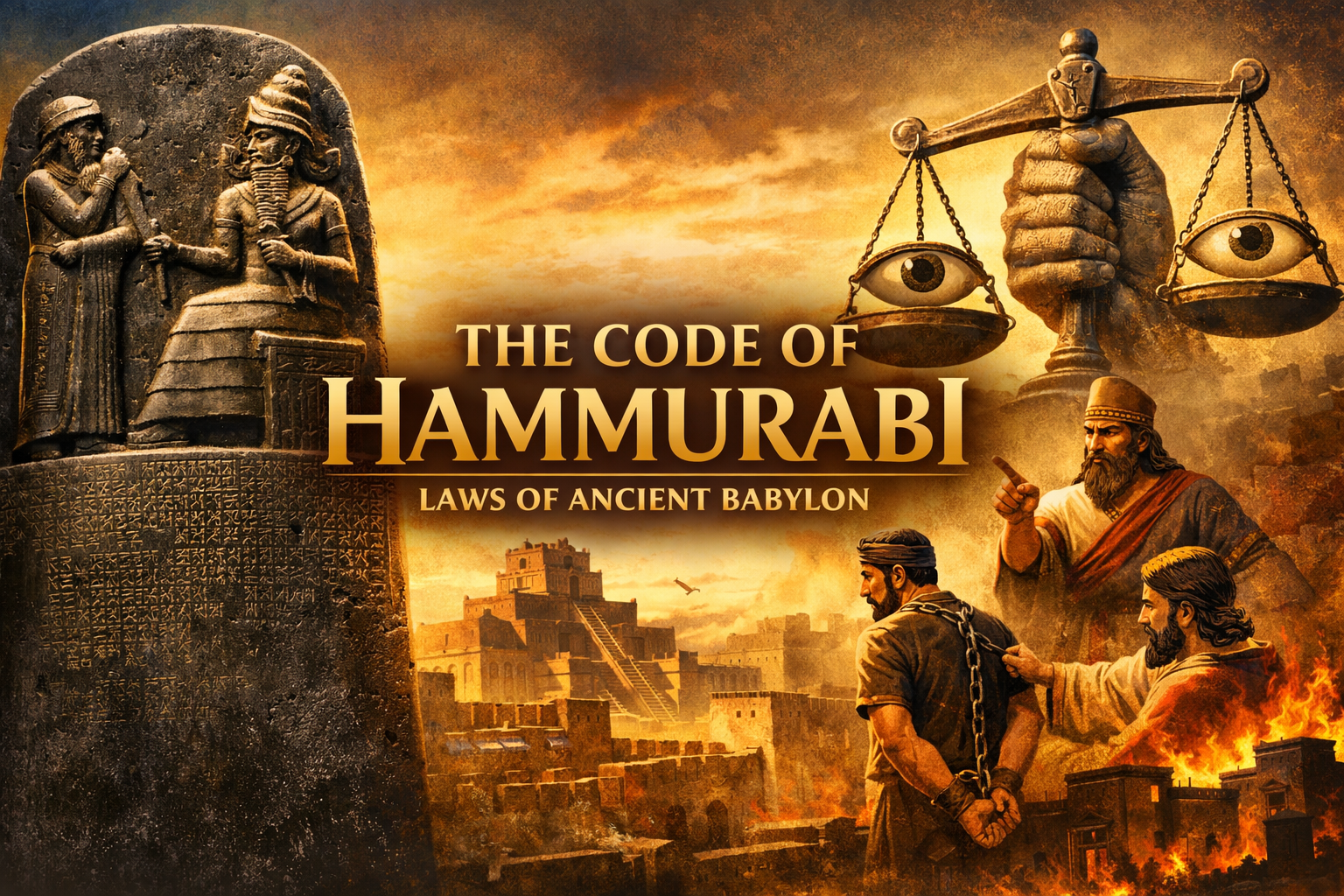
The Code of Hammurabi is one of the oldest written law collections in human history. It was created around 1754 BCE by Hammurabi, king of Babylon in ancient Mesopotamia (modern-day Iraq).
Imagine a country today publishing its entire criminal and civil law on a giant stone billboard in the city center. That is essentially what Hammurabi did — except his “billboard” was a 7-foot-tall black basalt stone pillar.
At the top of the stone, Hammurabi is shown standing before the sun god Shamash, symbolizing that his authority to rule and judge came from the divine. Below that image are nearly 300 laws carved in tiny wedge-shaped writing called cuneiform.
This was not just a legal document. It was a public declaration:
“These are the rules. This is how justice works.”
Why Was It Important?
Before written laws, justice was often unpredictable. If someone powerful wronged you, your outcome depended on status, connections, or the mood of the ruler.
Hammurabi’s innovation was not inventing laws — societies already had rules. His innovation was:
- Writing them down
- Standardizing them
- Making them public
It was like moving from “word-of-mouth justice” to a structured legal system.
Think of it as upgrading from informal community discipline to a published legal code like a modern constitution or penal code.
What Kind of Laws Did It Contain?
The Code covers almost every part of daily life:
- Theft
- Marriage and divorce
- Wages
- Farming
- Property disputes
- Slavery
- Contracts
- Assault
- Professional malpractice
Let’s break this down with real-life analogies.
“Eye for an Eye” — What Did That Really Mean?
One of the most famous principles from the Code is:
“If a man destroys the eye of another man, they shall destroy his eye.”
This is often summarized as “an eye for an eye.”
But this wasn’t random cruelty. It was actually a limitation on revenge.
Before such laws, revenge could spiral out of control:
- You injure someone’s eye.
- They kill your brother.
- You burn their house.
- The cycle continues.
Hammurabi’s idea was proportional justice:
Punishment must match the crime — no more, no less.
In modern terms, it’s like saying:
If someone steals ₦50,000, they shouldn’t receive a life sentence.
However — and this is important — the punishment depended on social class.
Social Class and Unequal Justice
Babylonian society had three major classes:
- Free upper-class citizens
- Commoners
- Enslaved people
If a noble injured another noble, the “eye for an eye” rule applied.
But if a noble injured a commoner, the punishment might be a fine instead.
In today’s terms, imagine if the law punished the wealthy differently than the poor for the same offense. That would feel unfair to us — and it was unequal then too.
The Code reflects the reality of its time: justice was structured, but not equal.
Real-Life Scenarios from the Code
Let’s look at some fascinating examples.
1. Builder Responsibility
If a builder constructed a house and it collapsed, killing the owner, the builder could be put to death.
Analogy:
Imagine hiring a contractor to build your house. If they use poor materials, and your house collapses due to negligence, modern law would sue them for malpractice or criminal negligence.
Hammurabi’s law took it further — it treated construction errors as life-and-death accountability.
This shows how seriously structural safety was taken.
2. Medical Malpractice
If a surgeon performed a major operation and the patient died, the surgeon’s hands could be cut off.
Brutal? Yes.
But notice something important:
The law recognizes professional responsibility.
This is an early version of malpractice law.
Today, doctors are not mutilated — but they can lose their licenses or face lawsuits. The principle is similar: expertise carries risk and accountability.
3. Wages and Contracts
The Code even set wages for workers like ox drivers and laborers.
Think of it as an early minimum wage regulation.
It also detailed how contracts should work — essentially saying:
“If you agree to something in writing, it must be honored.”
This shows that Babylon had a structured economy with loans, interest, rental agreements, and trade networks.
4. Flooding and Farming
If a farmer neglected their irrigation dam and it flooded a neighbor’s field, they had to compensate for the loss.
This is ancient environmental liability.
In modern terms:
If your factory pollutes a river and damages farmland, you must pay.
The Code recognized cause and consequence.
Was It Harsh?
Yes — by modern standards.
Punishments included:
- Death
- Mutilation
- Severe fines
But remember: this was nearly 4,000 years ago.
In context, the Code actually restrained arbitrary cruelty by making consequences predictable.
It moved society from personal revenge to rule-based justice.
Was It the First Law Code?
Not exactly.
Earlier law collections existed in Mesopotamia. However, the Code of Hammurabi is the most complete and best preserved.
What makes it iconic is:
- Its scale
- Its preservation
- Its influence
Later legal traditions — including some Biblical laws — show similarities in structure and principles of proportional justice.
The Stone Itself: A Symbol of Authority
The stele was placed in a public location so people could see it.
Ironically, most ordinary people likely couldn’t read it. Literacy was limited to scribes.
So why display it?
Because it symbolized something bigger:
Law is above individuals — even above the king.
It was political messaging:
“I rule by justice, not by whim.”
In modern terms, it’s like a government publishing its constitution online — not everyone reads every clause, but its existence signals order.
What Does It Tell Us About Civilization?
The Code shows that by 1754 BCE, Babylon had:
- A centralized government
- Courts and judges
- A tax system
- A trade economy
- Professional classes
- Written contracts
It reveals a complex, organized urban society.
Civilization wasn’t primitive chaos. It was structured, bureaucratic, and regulated.
Key Concepts Simplified
Codified Law
Rules written down and standardized.
Proportional Justice
Punishment matching the crime.
Social Stratification
Different classes with different legal outcomes.
Legal Accountability
Professionals responsible for their work.
Why It Still Matters Today
The Code of Hammurabi represents a turning point in human history:
It marks the shift from personal revenge to institutional justice.
Even though modern law rejects mutilation and unequal punishment, the foundational ideas remain:
- Law should be written.
- Law should be public.
- Law should define consequences.
- Authority should be structured, not random.
Every legal system today — from local courts to international criminal law — traces part of its ancestry to early codifications like this.
Final Reflection
Imagine living in a world where laws are not written, where judgment depends entirely on power or emotion.
Now imagine someone carving 282 rules into stone and saying:
“These apply to everyone.”
That is what Hammurabi attempted.
The Code of Hammurabi is not just an ancient artifact.
It is a milestone in humanity’s attempt to replace chaos with order — and revenge with regulation.
It is one of the first moments where civilization said:
Justice must have structure.