
Welcome to the Utopedia entry on Ratio Decidendi. This isn’t just an article; it’s an interactive journey. As you read, you’ll encounter inline links to explore deeper concepts, hover glossaries for instant clarification, and pathways to guide your next intellectual adventure.
Have you ever wondered why a single court case can send ripples through the legal system for centuries, while thousands of others are quietly forgotten? The answer lies in a hidden genetic code embedded within every judgment—a code so powerful that it can bind future judges, shape societies, and even alter the course of history. This secret DNA is called the Ratio Decidendi, Latin for “the reason for the decision.” It’s the skeleton key to understanding how law breathes, grows, and maintains its authority across generations.
Hover Glossary: Ratio Decidendi – The principle of law on which a court’s decision is founded. It is the binding part of a judgment that creates a precedent for future cases .
Let’s Navigate the Law’s Backbone
Before we dive deep, let’s orient ourselves. Ratio Decidendi doesn’t exist in a vacuum—it’s the centerpiece of a fascinating ecosystem of legal ideas. Here’s how it connects to the world around it:
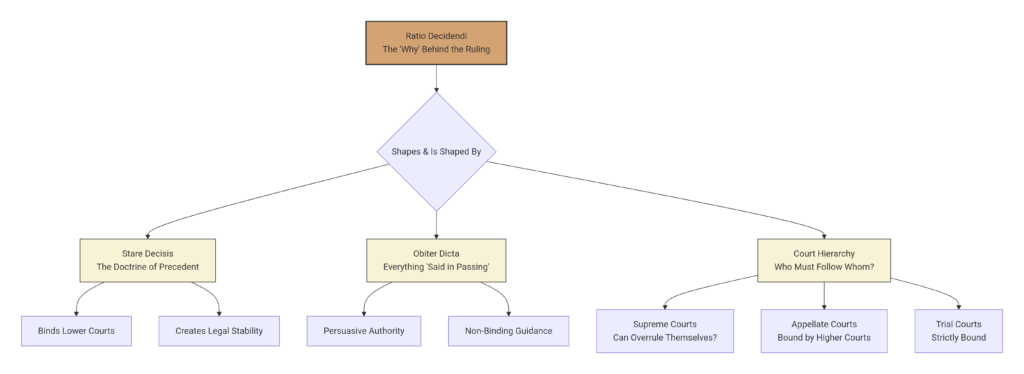
Related Concepts Panel:
- Stare Decisis: The “stand by decided matters” principle—the engine that runs on ratio fuel.
- Obiter Dicta: The judge’s comments made “by the way”—interesting, but not binding.
- Precedent: The legal rule born from a ratio that future courts must follow.
- Res Judicata: Different from ratio—this means “the matter has been judged” and prevents re-litigation of the same dispute .
Finding the Needle in the Legal Haystack
Here’s the catch: judges rarely put a neon sign around the ratio. It’s hidden, woven through pages of analysis, factual discussion, and legal reasoning. So how do legal detectives—lawyers and judges—extract it?
The “But For” Test: A Mental Scalpel
Imagine you’re a surgeon operating on a judgment. You need to remove everything that isn’t essential. The most powerful tool? The Inversion Test.
Did You Know? The Indian Supreme Court formalized the “inversion test” to identify ratio. If you reverse a legal proposition and the case outcome remains the same, that proposition cannot be the ratio decidendi .
Let’s watch it in action. Take a fictional case: Baker v. Sweet Shop. The court rules that the sweet shop is liable after a customer slipped on a spilled milkshake.
- Step 1: Extract a potential legal principle: “Shop owners are liable for injuries caused by spills.”
- Step 2: Invert it: “Shop owners are NOT liable for injuries caused by spills.”
- Step 3: Ask: If this inverted principle were true, would the outcome (shop liable) still be the same? No. Therefore, the original principle WAS essential—it’s part of the ratio.
Now test another statement from the judgment: “Milkshakes are delicious refreshments.” Invert it: “Milkshakes are NOT delicious.” Would the outcome change? Absolutely not. This is Obiter Dicta—interesting, perhaps true, but not legally binding .
The Material Facts Approach
Another method pioneered by legal scholar Professor Goodhart suggests looking at the material facts the judge deemed crucial. The ratio is the rule applied to those specific facts. Everything else—speculation about hypotheticals, historical musings, philosophical tangents—is obiter .
The Great Divide: Ratio vs. Obiter—A Comparative Lens
To truly understand ratio, you must see its shadow: Obiter Dicta. They are twins separated at birth—one with the power to bind, the other with only the power to persuade.
You might also wonder… Can obiter ever become binding? In some jurisdictions, like Australia, “seriously considered dicta” from the High Court carries significant weight, blurring the line between persuasion and obligation .
The Evolution of Ratio: A Timeline of Legal Power
The concept of ratio decidendi didn’t spring forth fully formed. It evolved over centuries, mirroring the development of common law itself.
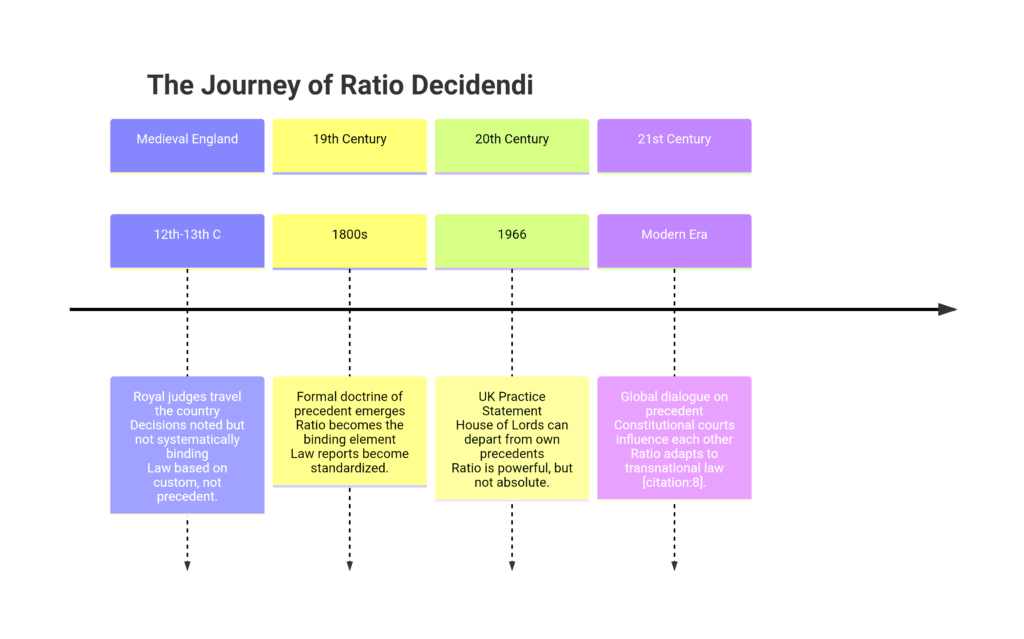
Deep Dive: The Anatomy of a Judgment
Expandable Deep-Dive Section (Click to Explore)
For the advanced reader, let’s dissect a judgment. A typical common law judgment has several layers:
- The Facts: What happened? Who did what to whom? This is the raw material.
- The Arguments: What did each side claim the law should be?
- The Analysis: The judge reviews precedents, statutes, and policy. This section is a minefield—containing both ratio and obiter.
- The Holding: The immediate answer to the legal question (e.g., “Defendant is liable”).
- The Reasoning (The Critical Part): Why is the defendant liable? Which legal principle, applied to these specific facts, compels this result? This is where you find the ratio.
- The Remedy: What happens next (damages, injunction, etc.).
Visual Metaphor: Think of a judgment as an iceberg. The outcome (who won) is the visible tip. The massive structure below the waterline is the reasoning—and buried deep within that structure is the ratio, the dense core of ice that gives the entire iceberg its shape and direction.
When Ratios Collide: Multiple Judges, Multiple Reasons
What happens when a case is decided by a panel of judges, and they all agree on the outcome but for different reasons? This is where ratio decidendi gets truly fascinating.
Imagine a supreme court case with three judges:
- Judge A bases their decision on Contract Law.
- Judge B agrees with the outcome but relies on Tort Law.
- Judge C agrees with both.
What is the ratio? Legal systems handle this through the concept of the “majority ratio.” If a majority of judges (at least two out of three) agree on a specific legal principle, that principle becomes the ratio. If they all agree on the result but offer irreconcilable reasons, the case’s precedential value is weakened—it stands only for its specific facts .
Did You Know? In some civil law systems like Italy, they use a concept called “massimario”—official summaries of court decisions that attempt to distill the ratio, much like headnotes in law reports. This bridges the gap between civil and common law traditions .
Thought Experiments with Ratio
Let’s step into a mental laboratory. Imagine you’re a judge in a new jurisdiction without centuries of precedent. You face your first case: The Case of the Exploding Soda.
The Facts: A bottling company’s soda bottle exploded, injuring a customer. There’s no relevant statute.
Your Task: You must decide for the customer. Now, write your judgment. The principle you announce—the rule about who bears responsibility for defective products—will become the ratio decidendi. It will bind every judge in every future case involving exploding bottles, faulty machinery, or even spoiled food.
This thought experiment reveals the immense responsibility behind every ratio. You’re not just solving a dispute; you’re legislating from the bench, crafting a rule that will live on long after the original parties have settled their accounts.
Future Implications: Ratio in the Age of AI and Global Law
As law becomes increasingly globalized and technology reshuffles the deck, what happens to ratio decidendi?
- AI Judges: If algorithms decide disputes, what is their “ratio”? Can machine learning models produce transparent, binding principles, or will they create un-auditable “black box” precedents?
- Transnational Precedent: Courts in different countries increasingly cite each other’s decisions, especially on human rights or constitutional issues. Is this a new form of persuasive authority—a kind of “soft ratio”?
- The Datafication of Law: With millions of judgments now digitized, can we algorithmically identify ratios across entire legal systems? Projects like Springer’s 2025 study on Ratio Decidendi and Obiter Dictum suggest we’re moving toward computational analysis of precedent .
Your Knowledge Journey: Where to Go Next
You’ve unlocked the secret of ratio decidendi. But every answer breeds new questions. Where should your curiosity lead you?
- For Beginners: If ratio is the binding principle, how do courts actually apply it to new facts? This is the art of analogical reasoning. Explore how lawyers argue that a precedent is “on all fours” (directly applicable) or “distinguishable.”
- For Advanced Learners: Dive into the Practice Statement 1966. When can the UK Supreme Court ignore its own ratio? This reveals the tension between legal stability and the need for change.
- For Philosophers: Question the very nature of precedent. Does a case have one “true” ratio, or is the ratio whatever a later court says it is? This is the heart of legal realism versus formalism.
Curated Reading Paths:
- Path A (The Practitioner): Ratio → Stare Decisis → Case Analysis → Appellate Advocacy
- Path B (The Theorist): Ratio → Legal Reasoning → Judicial Philosophy → Legal Realism
- Path C (The Comparative Lawyer): Ratio (Common Law) → Precedent in Civil Law → Massimario (Italy) → Global Judicial Dialogue
Quick Knowledge Check
- A judge comments on a hypothetical scenario in a ruling. Is this ratio or obiter? (Answer: Obiter)
- A lower court refuses to follow a higher court’s reasoning. Is this permissible? (Answer: No, if it was the ratio)
- If three judges give three different reasons for the same outcome, what is the ratio? (Answer: Possibly none—the case’s value is limited to its facts)
Knowledge Breadcrumbs: You are here: Home > Legal Concepts > Common Law Doctrine > Precedent > Ratio Decidendi
Next Concept to Learn: [Stare Decisis] | [Obiter Dicta] | [Judicial Reasoning]
Hidden Fact: Did you know that in patent law, the ratio decidendi of a board of appeal decision can bind the patent office in future examination of the same case after remission, ensuring that the legal reasoning is consistently applied ?
📚 From Solitary Reader to Community Scholar
You’ve just spent time with a complex idea, turning it over in your mind, connecting it to other concepts. That’s the beautiful, necessary work of solitary learning. But ideas are like coals: alone, they cool and fade. Together, they ignite.
Imagine stepping out of the quiet library stacks and into a bustling campus quad, where the air is thick with debate, discovery, and collaboration. That’s the UtopiaCircle Campus Network.
🎓 A Special Invitation for Students
If you’re a student—whether in high school, college, law school, or just a lifelong learner with a student’s heart—you don’t have to explore alone anymore. The UtopiaCircle Campus Network on Telegram is where the pages of this library come alive.
What happens inside the Campus Network?
- Live Idea Incubators: Reading about the “Inversion Test” for Ratio Decidendi is one thing. Debating it in real-time with a law student from London, a philosophy major from Buenos Aires, and a curious coder from Bangalore? That’s where deep understanding is forged. Bring your questions, and watch how fast they catch fire.
- Co-Create the Library: This isn’t just a place to consume knowledge; it’s where we build it. Share your own explanations, suggest connections we missed, or challenge the way we’ve framed a concept. Your insights could become the next “Did You Know?” nugget or the seed for an entirely new Utopedia entry.
- Peer-to-Peer Expeditions: Form reading groups, tackle difficult topics together, or simply ask for a recommendation when you don’t know which “Knowledge Breadcrumb” to follow next. The network is your guide, your study group, and your intellectual home base.
- Exclusive “Live” Events: Imagine a monthly “Concept Clinic” where we dissect a landmark case or a scientific theory together, or a “Guest Curator” session where a subject-matter expert from within the student community walks everyone through their favorite concept cluster.
Joining is simple: It’s a space for genuine curiosity, not noise. It’s where readers become writers, students become teachers, and the library becomes a living conversation.
“You might also wonder…” What if the next great legal mind—the one who will refine how we understand precedent for the next century—is sitting in this network right now, sparked by a conversation you started?
Your Knowledge Journey, Now with Company
So, as you close this article on Ratio Decidendi, you have a choice. You can file away what you’ve learned and continue on your own.
Or, you can click the link, join the UtopiaCircle Campus Network, and find your people.
The library is infinite. But you don’t have to navigate it alone.
<— [Join the UtopiaCircle Campus Network on Telegram]
See you on the quad.