Imagine walking into a world where the rules you know — of motion, time, and certainty — suddenly bend, twist, and shimmer like light through a prism. That world is quantum reality, the realm governed by Quantum Theory, where particles can be here and there at once, energy comes in discrete steps, and the act of looking changes what exists. Read also, Quantum State.
Quantum Theory is humanity’s story of discovering the invisible choreography of nature. It is the map of the unseen, the grammar of the atomic and subatomic world, and the reason your existence follows patterns written in probabilities rather than certainties.
The Birth of the Quantum Tale
It begins with Max Planck, at the edge of the 20th century, staring at the problem of blackbody radiation — why hot objects emit light in specific patterns. He discovered that energy comes in packets, or quanta, like coins being dropped one by one into a jar rather than a continuous flow.
Imagine filling a jar with water, but the water can only enter in tiny droplets. No matter how you pour, you cannot make it flow continuously — that is the first whisper of the quantum world. Energy, Planck realized, is not infinitely divisible; it moves in steps, setting the stage for a universe that is granular at its core.
The Wave-Particle Paradox
Then comes light itself — familiar yet mysterious. Is it a wave, like ripples in a pond, spreading smoothly and interfering with itself? Or is it a particle, like marbles bouncing along a floor? Experiments revealed the duality of light: it is both and neither, depending on how we look. See Wave Function.
Consider a crowd at a music festival. From afar, you see the wave of movement — everyone swaying together. Up close, you notice individuals dancing, each with their own rhythm. Light behaves in the same dual way: as a wave of probabilities and as a particle called a photon.
This duality is not a flaw in nature — it is its poetry. It shows us that reality is contextual, and observation is a part of existence itself.
Quantum States and Superposition
Electrons orbiting atoms are not little planets tracing fixed paths; they exist in a cloud of possibilities. Until we observe them, they are in a superposition — simultaneously in multiple states.
Think of it like a spinning coin hovering in the air. It is both heads and tails until it lands. In the quantum world, electrons, photons, and other particles are spinning coins of reality, and measurement is the act that collapses them into one visible outcome.
Entanglement: The Whisper Between Particles
Here the story takes a stranger turn. Two particles can become entangled, meaning their states are linked, no matter the distance separating them. Change one, and the other responds instantly — a cosmic conversation faster than light.
Imagine two dancers in different cities who can perfectly mirror each other’s movements, even without seeing or hearing one another. That is entanglement: nature’s hidden choreography, suggesting that the universe is connected in ways our classical intuition cannot grasp.
Quantum Tunneling: Passing Through the Impossible
In the quantum realm, particles occasionally do what would seem impossible: they pass through barriers they shouldn’t be able to cross. This is called quantum tunneling.
Picture a tiny ball rolling towards a hill. In the classical world, it needs enough energy to climb over. In the quantum world, the ball sometimes appears on the other side without climbing at all, as if it found a secret passage. Tunneling powers technologies from semiconductors to nuclear fusion in stars, turning impossibility into reality.
The Measurement Puzzle
Quantum Theory teaches us that observation changes reality. The famous double-slit experiment illustrates this beautifully. Electrons fired at two slits create an interference pattern like waves — unless someone watches which slit they pass through, in which case they behave like particles.
It is as if reality knows it is being observed, reshaping itself in response. Imagine a crowd that dances one way when cameras are off and freezes into strict patterns when filmed. Observation is part of the story — the universe’s plot is interactive.
Energy Levels, Orbitals, and the Atomic Symphony
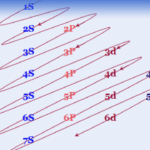
At the heart of atoms, electrons occupy discrete energy levels. They can jump between levels by absorbing or emitting a quantum of energy, like notes in a cosmic symphony. See also: Quantum State, Electronic Configuration
Visualize a ladder of floating platforms. Electrons hop from one to another, never in between, each move producing a “note” of energy. This discrete energy is why lasers emit precise beams, stars shine, and chemistry unfolds with predictable patterns.
Cross-Connections Across Science
Quantum Theory is not just for physicists. It is the foundation of chemistry, biology, and technology:
- Chemistry: Electrons in orbitals define bonds, reactions, and molecular structures.
- Biology: Quantum tunneling may play roles in photosynthesis and enzyme function.
- Technology: Quantum computers, semiconductors, lasers, and MRI machines rely on quantum principles.
- Cosmology: Stars, black holes, and the evolution of the universe follow quantum rules on microscopic scales, influencing macroscopic outcomes.
Every concept in quantum mechanics links to others like a living ecosystem — superposition connects to entanglement, which connects to tunneling, which connects to energy quantization. Understanding one is easier when seen as part of the whole web.
Visualizing Quantum Reality
Imagine a concept diagram:
- Central Node: Quantum Theory
- Connected Nodes: Superposition, Entanglement, Tunneling, Wave-Particle Duality, Energy Quantization
- Cross-links:
- Superposition ↔ Measurement
- Entanglement ↔ Nonlocality
- Energy Levels ↔ Atomic Spectra ↔ Lasers
- Tunneling ↔ Semiconductors ↔ Nuclear Fusion
Every node is a story, every link a pathway to another mystery.
Quantum Theory as a Narrative
Quantum Theory is a tale of possibility, individuality, and connectivity. It teaches that:
- Reality is probabilistic, not deterministic.
- Observation is not passive — it is part of the plot.
- Particles are both objects and waves — dual characters in the cosmic drama.
- The smallest scales of existence ripple outward to shape everything we see.
By understanding these principles, we see the universe not as a rigid machine, but as an interactive, living tapestry, where every particle, photon, and electron has a role in the unfolding story.
Final Thought
To read Quantum Theory is to read the universe’s diary. Every superposition is a sentence of possibility. Every entanglement is a whispered secret. Every quantum leap is a dramatic twist.
It is a story without beginning or end, written in probabilities, obeying laws stranger than fiction, yet shaping the reality we touch, see, and become.
Quantum Theory is the poetry of the invisible, the rhythm beneath the material world, and the ultimate narrative of nature itself.