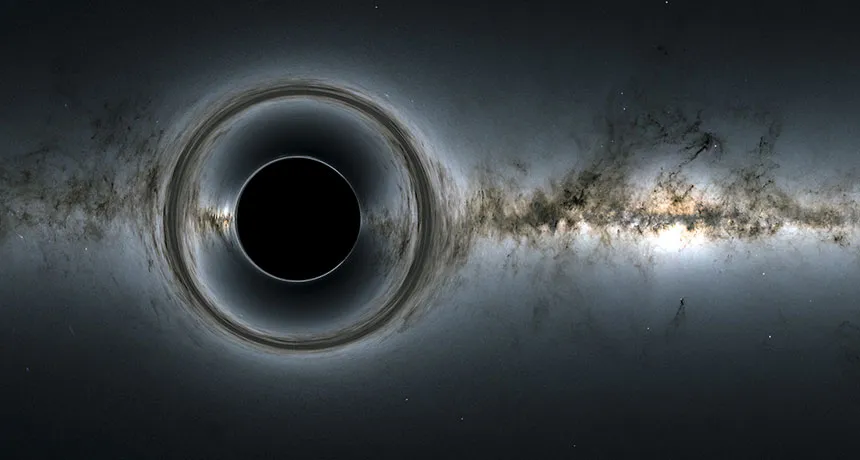
Imagine a cosmic lighthouse so powerful that nothing—not even light—can escape its pull. This is a black hole, one of the universe’s most mysterious objects. For decades, black holes were thought to be “cosmic vacuum cleaners,” swallowing everything that came near and never letting anything escape. Yet, in 1974, physicist Stephen Hawking revealed a stunning truth: black holes aren’t entirely black. They emit a faint glow, now called Hawking Radiation. But to truly appreciate this phenomenon, we need to understand how it connects to black body radiation, quantum mechanics, and the very fabric of spacetime.
Black Body Radiation: The Warm Glow of Matter
Before we look at black holes, let’s start with something simpler: black body radiation. A black body is an idealized object that absorbs all incoming light and energy. It doesn’t reflect or let anything escape. When it gets hot, it emits light based solely on its temperature.
Think of a metal rod in a fire. As it heats up, it glows red, then orange, then yellow. This glow is its black body radiation. The color tells us the temperature. Hotter objects emit higher energy light.
Mathematically, black body radiation follows Planck’s law, which describes how much energy is emitted at each wavelength. What’s crucial here is that the hotter an object, the more energy it emits—and the shorter the wavelength of the light. For humans, our body temperature (around 37°C) is too low to glow visibly, but we do emit infrared radiation—essentially, heat.
Now, what if we apply this idea to a black hole? That’s where Hawking’s genius comes in.
Quantum Fields Meet Gravity
Black holes are extremely dense regions of space where gravity is so strong that even light cannot escape. This creates an event horizon—the point of no return. But the universe isn’t empty. Space itself is a seething froth of quantum fluctuations, tiny temporary particles that pop in and out of existence. These are called virtual particle pairs.
Imagine the vacuum of space as a bubbling pot of water. Tiny bubbles appear and vanish constantly. In the quantum world, particles and antiparticles spontaneously emerge in pairs: one with positive energy, one with negative energy. Normally, they annihilate each other instantly, leaving no trace.
However, near a black hole’s event horizon, something extraordinary happens. Sometimes, a particle escapes while its partner falls into the black hole. To an outside observer, it looks as if the black hole is emitting particles—this is Hawking Radiation.
How Does Hawking Radiation Work?
Let’s break it down with a simple analogy:
Imagine standing on the edge of a waterfall with a friend. You both toss a pair of balls connected by an invisible spring. One ball falls over the edge, pulled into the torrent, while the other bounces back toward you. The ball that bounces back is like the particle escaping the black hole; the one that falls is like its partner, which effectively reduces the black hole’s mass.
This process causes the black hole to slowly lose mass over time—a phenomenon called black hole evaporation. The smaller the black hole, the hotter and brighter the radiation. Over astronomical timescales, tiny black holes could completely evaporate.
Mathematically, the temperature of a black hole (called the Hawking temperature) is inversely proportional to its mass:TH=8πGMkBℏc3
Where:
- TH is the Hawking temperature
- ℏ is the reduced Planck constant
- c is the speed of light
- G is the gravitational constant
- M is the mass of the black hole
- kB is Boltzmann’s constant
Notice that massive black holes are extremely cold. A black hole with the mass of our Sun would have a Hawking temperature of only a fraction of a billionth of a degree above absolute zero. That’s colder than the space between stars.
Why It Matters
Hawking Radiation unites three pillars of physics: general relativity, quantum mechanics, and thermodynamics.
- From general relativity, we get the black hole’s curvature of spacetime and the event horizon.
- From quantum mechanics, we understand particle fluctuations near the horizon.
- From thermodynamics, we can assign temperature and entropy to black holes, leading to the concept that black holes have information and obey physical laws, not just swallow matter blindly.
This insight has profound implications for the information paradox, a long-standing puzzle about whether information falling into a black hole is lost forever—a question that challenges our understanding of the universe.
Real-Life Analogies and Thought Experiments
- Cosmic Fireplace:
Picture a black hole as a fireplace in the cosmic room. The fire is invisible because the room is too cold, but faint wisps of smoke (Hawking radiation) slowly rise, carrying energy away. - Quantum Coin Toss:
Think of virtual particles as coins flipping in and out of existence. Near the event horizon, the coins sometimes land in a way that one escapes—like catching a coin on the edge of a table while its partner falls. - Evaporating Ice Cube:
A black hole slowly losing mass is like an ice cube melting in a warm room. At first, it barely melts (massive black holes), but as it gets smaller, it disappears faster, leaving only a trace of water (radiation).
Cross-References
- Black Body Radiation – Explains the emission of energy from any object based on temperature.
- Event Horizon – The boundary around a black hole beyond which nothing can return.
- Quantum Fluctuations – Tiny, temporary changes in energy that produce virtual particles.
- Black Hole Evaporation – The process by which black holes lose mass over time due to Hawking Radiation.
- Information Paradox – The question of whether information falling into a black hole is lost forever.
Glossary
- Hawking Radiation: Radiation emitted by black holes due to quantum effects near the event horizon.
- Black Body: An idealized object that absorbs all incident radiation and emits energy based on temperature.
- Virtual Particles: Temporary particle-antiparticle pairs that exist for a brief moment due to quantum fluctuations.
- Event Horizon: The “point of no return” around a black hole.
- Entropy: A measure of disorder or information content in a system.
In Conclusion
Hawking Radiation transforms our view of black holes from eternal cosmic prisons to dynamic, almost living entities that breathe out energy. It’s a whisper from the universe, hinting at the deep unity between the very large (gravity) and the very small (quantum mechanics). Every particle that escapes carries a story—a story about the black hole, the space around it, and the rules that govern the cosmos.
In the grand scheme, this radiation is faint and nearly impossible to detect from stellar black holes, but conceptually, it reshapes how we understand life, death, and energy in the universe. The universe, as Hawking showed, isn’t static; even the darkest regions have a subtle glow, reminding us that physics is full of surprises waiting to be uncovered.