Imagine a place where gravity becomes so strong that not even light can escape. Not a rocket. Not a signal. Not time as you know it. That place is a black hole — one of the most extreme objects in the universe.
But despite the name, black holes are not empty holes. They are ultra-compressed regions of space where matter has been squeezed so tightly that the normal rules of reality start to bend.
How a Black Hole Is Born
Think about a massive star — far bigger than our Sun — living its life by burning fuel in its core. This burning creates pressure that pushes outward, while gravity pulls inward. As long as these forces balance, the star lives.
When the fuel runs out, the outward pressure disappears. Gravity wins.
The star collapses in on itself so violently that it crushes its core into an incredibly tiny point. Imagine taking the mass of several Suns and compressing it into something smaller than a city. That collapse creates a black hole.
It’s like a building whose support columns suddenly vanish — everything falls inward, faster and faster, until it becomes something entirely new.
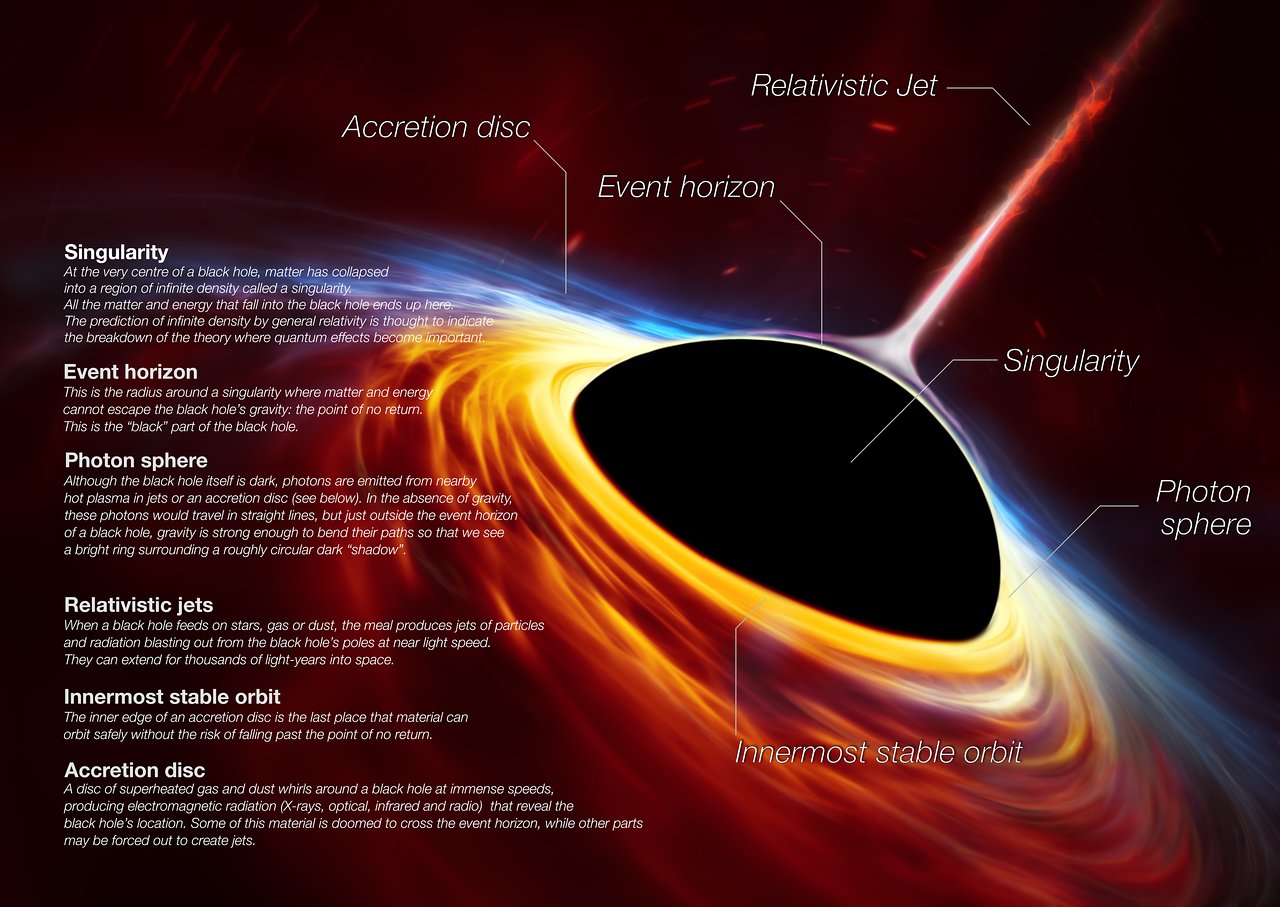
The Event Horizon — The Point of No Return
Every black hole has a boundary called the event horizon.
This is not a surface you can stand on. It is more like a cosmic waterfall edge.
If you are far away, you can still escape its pull. But once you cross that invisible line, escape becomes impossible — not because something blocks you, but because space itself is flowing inward faster than anything can move outward.
Even light, the fastest thing in the universe, cannot climb back out.
What It Would Feel Like
Falling toward a black hole would be very strange.
From far away, someone watching you would see you slow down, your clock ticking more and more slowly. To them, you would appear frozen at the edge, fading and reddening.
But for you, time would feel normal. You would fall straight through.
As you got closer, gravity would pull harder on your feet than on your head. You would stretch like spaghetti — a process scientists actually call spaghettification.
It sounds dramatic because it is. Black holes are not just strong — they stretch space itself.
The Singularity — Where Physics Breaks
At the center of a black hole lies something we do not fully understand: the singularity.
This is a point where all the mass is crushed into zero volume, and density becomes infinite. Our current physics cannot describe it properly.
It’s like reaching a page in a book where the text stops making sense — not because nothing is there, but because we don’t yet have the language to describe it.
Do Black Holes Suck Everything In?
Black holes do not roam the universe like cosmic vacuum cleaners.
If the Sun were magically replaced by a black hole of the same mass, Earth would continue orbiting normally. Why? Because gravity depends on mass, not on whether that mass is a star or a black hole.
They only become dangerous if you get very close.
So they are more like deep wells in space than hungry monsters.
The Bright Side of Black Holes
Ironically, black holes are often surrounded by the brightest objects in the universe.
As gas and dust fall toward them, they heat up and spin into a glowing disk called an accretion disk. This disk can shine brighter than entire galaxies.
Some black holes also launch jets of energy that shoot across space for thousands of light-years. These jets can shape galaxies and trigger star formation.
So black holes are not just destroyers — they are also cosmic engines that help build structure in the universe.
Supermassive Black Holes — The Giants
At the center of almost every galaxy, including our Milky Way, lies a supermassive black hole with millions or billions of times the mass of the Sun.
Our galaxy’s central black hole is called Sagittarius A*. It holds the Milky Way together gravitationally, like a hidden anchor.
These giants likely grew by merging with other black holes and by feeding on surrounding matter over billions of years.
Can Black Holes Die?
Surprisingly, yes.
According to quantum physics, black holes slowly lose energy through something called Hawking radiation. Over unimaginable timescales — far longer than the current age of the universe — they can evaporate.
So even these seemingly eternal objects have a lifespan.
Why Black Holes Matter
Black holes help scientists test the limits of physics. They connect gravity, time, space, and quantum theory in ways we do not yet fully understand.
They also help us answer deep questions:
- What happens to information that falls in?
- Can space and time be torn or connected?
- How did galaxies form?
Studying black holes is like studying the edge of reality itself.
A Simple Way to Picture It
Imagine space as a stretched rubber sheet.
A planet makes a small dent.
A star makes a deep dip.
A black hole punches a hole so deep that the sheet folds inward.
Now imagine that hole also slows time, bends light, and traps everything that crosses a certain line.
That is a black hole.
In Simple Terms…
A black hole is not just an object. It is a region where gravity becomes so extreme that space, time, and light behave in ways that feel almost unreal.
It is the universe showing us that reality has limits — and that beyond those limits lies mystery.
Key Facts Recap
- Formed from the collapse of massive stars
- Event horizon = point of no return
- Singularity = unknown core where physics breaks down
- Surrounded by bright accretion disks and powerful jets
- Supermassive versions sit at galaxy centers
- Can slowly evaporate over vast timescales