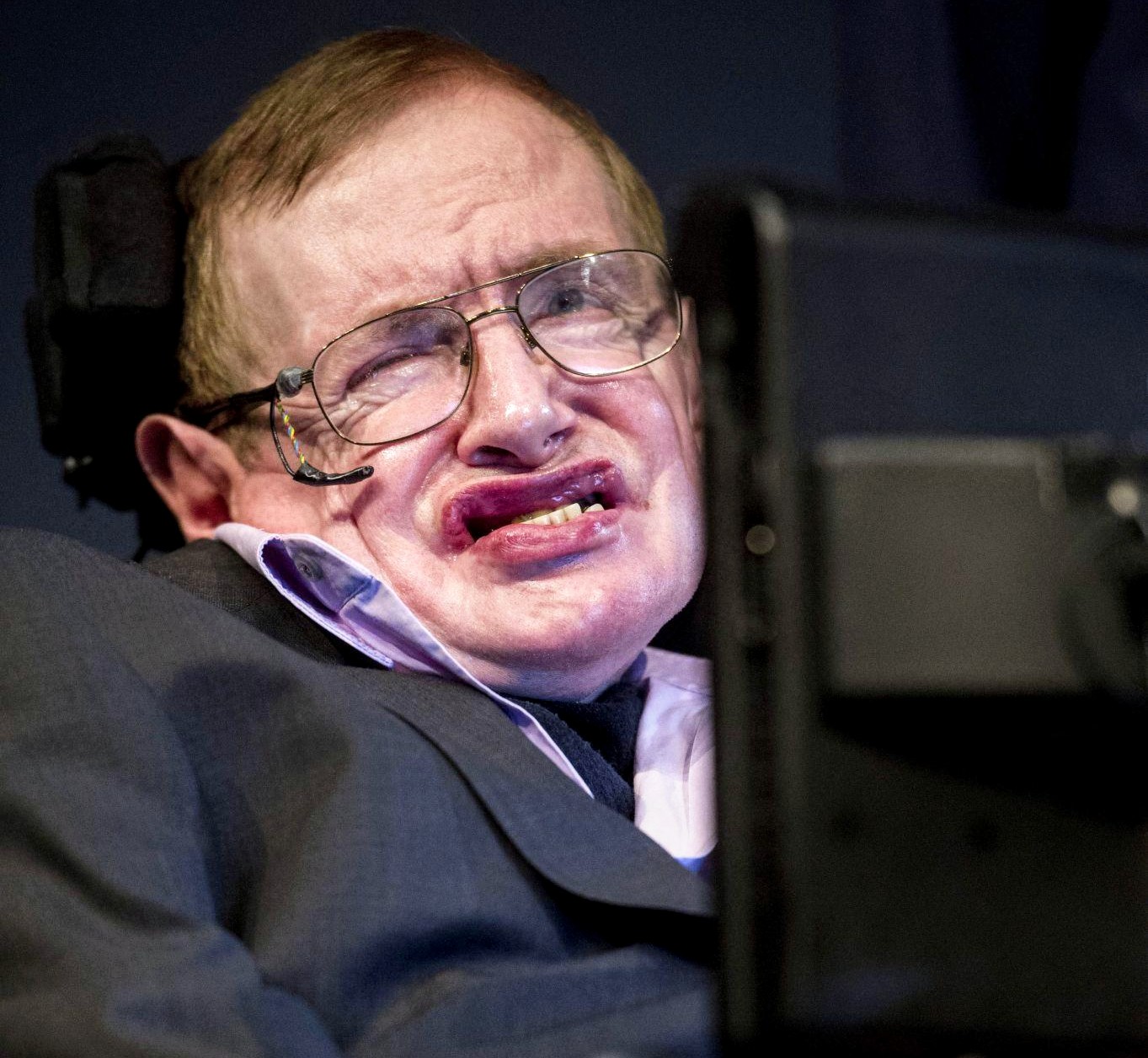
Stephen Hawking (1942–2018) was an English theoretical physicist and cosmologist whose work transformed modern understanding of black holes and the origins of the universe. Despite being paralyzed by motor neuron disease (ALS), he became a global symbol of scientific curiosity, resilience, and the power of human intellect.
Key facts
- Full name: Stephen William Hawking
- Born–Died: January 8 1942 – March 14 2018
- Fields: Theoretical physics, cosmology, and general relativity
- Major work: Discovery of Hawking radiation (1974)
- Notable book: A Brief History of Time (1988)
- Affiliation: University of Cambridge
Early life and education
Born in Oxford to academically inclined parents, Hawking grew up in St Albans, England. He attended University College, Oxford (B.A., 1962) and Trinity Hall, Cambridge (Ph.D., 1966). His early research, supervised by Dennis Sciama, focused on cosmology and singularities in space-time. At 21, he was diagnosed with amyotrophic lateral sclerosis (ALS) and given only a few years to live—a prognosis he defied for more than five decades.
Scientific contributions
Hawking’s collaboration with Roger Penrose established that the universe likely began from a singularity governed by general relativity. His most celebrated breakthrough came in 1974, when he demonstrated that black holes emit radiation—now called Hawking radiation—linking quantum mechanics, thermodynamics, and relativity in a single framework. This insight reshaped theoretical physics and remains central to efforts to reconcile quantum theory with gravity.
Popular science and public influence
Through books such as A Brief History of Time, The Universe in a Nutshell, and The Grand Design (co-authored with Leonard Mlodinow), Hawking made complex cosmological ideas accessible to a mass audience. The first sold over 10 million copies and remained on bestseller lists for years. His voice synthesizer and wry humor made him a distinctive cultural figure, appearing on Star Trek: The Next Generation, The Simpsons, and The Big Bang Theory.
Recognition and legacy
Hawking held Cambridge’s Lucasian Professorship of Mathematics from 1979 to 2009, once occupied by Isaac Newton. Honors included the Copley Medal (2006), the Presidential Medal of Freedom (2009), and interment at Westminster Abbey beside Newton and Charles Darwin. His life inspired the Oscar-winning film The Theory of Everything (2014). Beyond physics, he championed science literacy, universal healthcare, and the exploration of space as humanity’s future frontier.